eUICC.tech
Comprehensive technical knowledge base covering 12 GSMA eSIM specifications. 84+ articles on Remote SIM Provisioning — SGP.02, SGP.22, SGP.32, SGP.41, SGP.29, SGP.23, SGP.25, SGP.26 and more.
Project maintained by AlexsCodingAgent Hosted on GitHub Pages — Theme by mattgraham
The Developer’s View: RSP Interfaces and Protocol Binding
eUICC.tech > SGP.22 Consumer RSP > The Developer’s View: RSP Interfaces and Protocol Binding
Why this matters: If you’re building an LPA, an SM-DP+, or integrating eSIM into a device, this is your reference. Every function signature, HTTP endpoint, ASN.1 structure, and protocol binding rule is standardised: you just need to know where to look.
Key takeaways:
- Four interface families (
ES2+,ES8+,ES9+,ES10x) cover ordering, secure delivery, LPA-server communication, and local chip accessES2+andES9+use HTTP/JSON with standardised headers;ES8+uses ASN.1 TLV encoding with SCP03t transport securityES10xis the APDU-level interface over ISO 7816: there are 11ES10bfunctions and 7ES10cfunctions- Every function call carries a
functionCallIdentifierfor idempotency, retry safety, and audit trails- The SM-DS introduces an event-driven decoupling pattern: profiles can be generated today and discovered next week
- The Developer’s View: RSP Interfaces and Protocol Binding
For developers implementing eSIM support: whether building an LPA, an SM-DP+, or integrating with an eUICC: understanding the function-level API and wire protocol is essential. SGP.22 defines every function call, every TLV structure, and both JSON and ASN.1 serialisation formats.
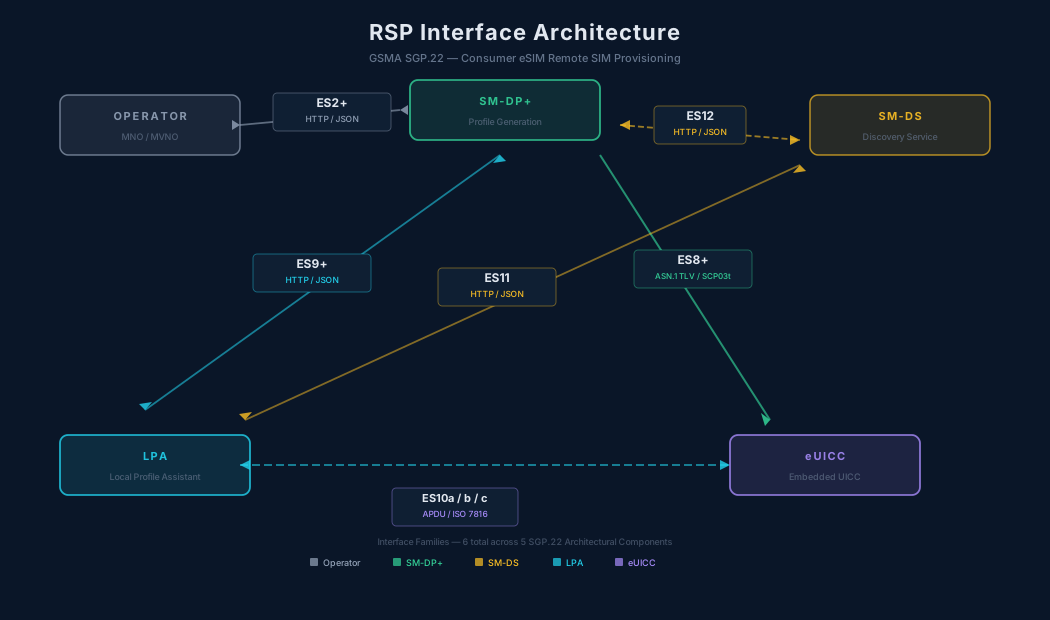
The ES2+ Interface: Operator to SM-DP+
The interface where profiles are ordered. All functions are HTTP/JSON.
DownloadOrder
Reserves an ICCID and optionally a profile type for an eUICC.
POST /gsma/rsp2/es2plus/downloadOrder

Request:
{
 "header": { "functionRequesterIdentifier": "...", "functionCallIdentifier": "..." },
 "eid": "8901...", // Optional: required if ICCID not specified
 "iccid": "8944...", // Optional
 "profileType": "..." // Optional: if ICCID is not present
}

Response:
{
 "header": { "functionExecutionStatus": { "status": "Executed-Success" } },
 "iccid": "8944..." // The reserved ICCID
}
ConfirmOrder
Finalises the order and triggers profile preparation.
POST /gsma/rsp2/es2plus/confirmOrder

Request:
{
 "header": { ... },
 "iccid": "8944...", // Required
 "eid": "8901...", // Optional: required if not in DownloadOrder
 "matchingId": "...", // If empty, SM-DP+ generates it for Activation Code
 "confirmationCodeRequired": true, // Optional: requires user to enter code
 "smdsAddress": "https://...", // Required for SM-DS delivery
 "releaseFlag": true
}

Response:
{
 "header": { ... }
}
The ES8+ Interface: SM-DP+ to eUICC
The secure end-to-end channel tunnelled through the LPA. Uses SCP03t for transport security on top of the session keys.
InitialiseSecureChannel
Establishes the ECDH key agreement and derives session keys (S-ENC, S-MAC).
BoundProfilePackage.initialiseSecureChannelRequest ::= [35] SEQUENCE {
 remoteOpId INTEGER, // ID reference
 transactionId TransactionId, // From mutual auth
 controlRefTemplate OCTET STRING, // Key agreement parameters
 smdpOtpk OCTET STRING, // SM-DP+ one-time public key (ECDH)
 smdpSign OCTET STRING // SM-DP+ signature
}
ConfigureISDP
Creates the ISD-P with specified configuration. Encrypted and MACed with SCP03t.
StoreMetadata
Writes Profile Metadata (ICCID, name, operator, policy rules). MAC-only (not encrypted).
ReplaceSessionKeys
Swaps session keys for pre-computed profile protection keys. Optional.
LoadProfileElements
Streams the profile payload in SCP03t segments. Called repeatedly until the complete profile is delivered.
The ES10x Interface: LPA to eUICC
The local interface between the device and the chip. Implemented as APDU commands over the ISO 7816 interface (the same physical interface your SIM reader would monitor).
ES10a Functions (Discovery)
| Function | Purpose |
|---|---|
GetEuiccConfiguredAddresses |
Returns configured SM-DP+ and SM-DS addresses |
SetDefaultDpAddress |
Sets the default SM-DP+ address on the eUICC |
ES10b Functions (Profile Download)
| Function | Purpose |
|---|---|
PrepareDownload |
Initialises profile download session on eUICC |
LoadBoundProfilePackage |
Delivers BPP segments to eUICC for installation |
GetEUICCChallenge |
Requests fresh random challenge for mutual auth |
GetEUICCInfo |
Returns euiccInfo1 and euiccInfo2 |
ListNotification |
Returns list of pending SM-DS events |
RetrieveNotificationsList |
Gets notification metadata for a specific event |
RemoveNotificationFromList |
Deletes a processed notification |
LoadCRL |
Loads Certificate Revocation List onto eUICC |
AuthenticateServer |
Forwards server authentication data for eUICC verification |
CancelSession |
Cancels an in-progress profile download |
GetRAT |
Retrieves Rules Authorisation Table |
ES10c Functions (Local Management)
| Function | Purpose |
|---|---|
GetProfilesInfo |
Returns all installed profiles with metadata |
EnableProfile |
Activates a specific profile |
DisableProfile |
Deactivates a profile |
DeleteProfile |
Permanently removes a profile |
eUICCMemoryReset |
Factory resets the eUICC |
GetEID |
Returns the eUICC’s unique identifier |
SetNickname |
Assigns user-friendly name to a profile |
The ES9+ Interface: LPA to SM-DP+
HTTP/JSON interface for the LPA to communicate with the SM-DP+.
// InitiateAuthentication
POST /gsma/rsp2/es9plus/initiateAuthentication
{
 "euiccChallenge": "base64...",
 "euiccInfo1": "base64...",
 "smdpAddress": "example.smdp.com"
}

// AuthenticateClient
POST /gsma/rsp2/es9plus/authenticateClient
{
 "transactionId": "...",
 "authenticateServerResponse": "base64...",
 "authenticateClientRequest": {
 "euiccSigned1": "base64...",
 "euiccSignature1": "base64...",
 "euiccCertificate": "base64...",
 "eumCertificate": "base64..."
 }
}

// GetBoundProfilePackage
POST /gsma/rsp2/es9plus/getBoundProfilePackage
{
 "transactionId": "...",
 "prepareDownloadResponse": "base64..."
}
Protocol Binding Options
SGP.22 supports two serialisation formats:
JSON Binding
All ES2+, ES9+, and ES11 interfaces use JSON. Messages follow a request-response pattern with a standard header containing:
{
 "header": {
 "functionRequesterIdentifier": "operator-id",
 "functionCallIdentifier": "uuid",
 "functionExecutionStatus": {
 "status": "Executed-Success",
 "statusCodeData": { ... }
 }
 }
}
Status codes include success states (Executed-Success), error states (Failed), and expiration states.
ASN.1 Binding
The ES8+ interface (SM-DP+ → eUICC) and the Bound Profile Package structure use ASN.1 with TLV encoding. The ASN.1 definitions occupy Annex H of the specification: hundreds of lines of structured type definitions. The BPP structure itself is defined as:
BoundProfilePackage ::= [54] SEQUENCE {
 initialiseSecureChannelRequest [35] InitialiseSecureChannelRequest,
 firstSequenceOf87 [0] SEQUENCE OF [7] OCTET STRING,
 sequenceOf88 [1] SEQUENCE OF [8] OCTET STRING,
 secondSequenceOf87 [2] SEQUENCE OF [7] OCTET STRING OPTIONAL,
 sequenceOf86 [3] SEQUENCE OF [6] OCTET STRING
}
The tag numbers ([54], [35], [0], etc.) correspond to the single-byte TLV tags used in the SCP03t transport layer (BF36, BF23, A0, A1, etc.).
HTTP and TLS Requirements
All server-to-server and device-to-server communication uses HTTPS with TLS:
- TLS 1.2 minimum, with specific cipher suites mandated
- Server authentication mode for
ES9+andES11(the server presents a certificate, the client does not) - Certificate validation against the GSMA CI chain
- HTTP response codes standardised:
200 OK: function executed400 Bad Request: malformed request401 Unauthorized: authentication failure500 Internal Server Error: unexpected server error
Event-Driven Architecture
The SM-DS system introduces an event-driven pattern:
- SM-DP+ registers Event via
ES12:RegisterEvent(EID, EventID, SM-DP+ address) - Device polls SM-DS via
ES11:InitiateAuthentication → AuthenticateClient(mutual auth), then retrieves pending events - SM-DS cascading: Events can propagate through multiple SM-DS instances via
ES15for global coverage - Event deletion: After profile download, the SM-DP+ deletes the Event via
ES12:DeleteEvent(EID, EventID)
This decouples profile availability from download timing: the SM-DP+ can generate a profile today, and the device can discover it next week.
Function Call Identifiers
Every function call includes a functionCallIdentifier : a unique ID that enables:
- Idempotency: Repeating the same call with the same ID produces the same result
- Retry logic: Network failures can be retried without risk of double-execution
- Audit trails: Every operation in the system can be traced by its call ID
Summary
- Four interface families cover the full eSIM lifecycle:
ES2+(ordering, JSON),ES8+(secure delivery, ASN.1/SCP03t),ES9+(LPA-server, JSON), andES10x(local chip access, APDU) - The
ES8+Bound Profile Package uses ASN.1 TLV encoding with SCP03t encryption: five function calls carry the entire profile payload through an untrusted LPA ES10bprovides 11 functions for profile download orchestration;ES10cprovides 7 for local management: all over ISO 7816 APDUsfunctionCallIdentifierheaders provide idempotency, retry safety, and end-to-end auditability across every interface- The SM-DS event pattern (
ES11/ES12/ES15) decouples profile generation from delivery timing, enabling global-scale deferred provisioning
Based on GSMA SGP.22 v2.7 (24 April 2026), Sections 5 and 6: Functions and Interface Binding
| ← Previous: Managing Your eSIM: Local Profile Operations | Section Index | Next: SGP.22 v2.7: LPAe: The In-eUICC Local Profile Assistant → |