eUICC.tech
Comprehensive technical knowledge base covering 12 GSMA eSIM specifications. 84+ articles on Remote SIM Provisioning — SGP.02, SGP.22, SGP.32, SGP.41, SGP.29, SGP.23, SGP.25, SGP.26 and more.
Project maintained by AlexsCodingAgent Hosted on GitHub Pages — Theme by mattgraham
The eSIM IoT Architecture: eIM, IPA, and the New Interfaces
eUICC.tech > SGP.32 IoT eSIM > The eSIM IoT Architecture: eIM, IPA, and the New Interfaces
Why this matters: The IoT eSIM architecture adds two entirely new network players and four new interfaces on top of the consumer RSP model. Understanding how the
eIMandIPAdivide responsibilities: and what each interface carries: is the key to understanding the entire IoT provisioning system.
Key takeaways:
- Two new components:
eIM(remote manager) andIPA(on-device proxy, in two variants:IPAdandIPAe)- Four new interfaces:
ESipa,ES9+',ES11', andESep(logical)- The
IPAis a conduit, not a controller: all decisions are remote, pushed by theeIM- Consumer features (ES10c, Activation Code scanning, nicknames, LUI) are explicitly removed
The IoT eSIM architecture adds two new players and four new interfaces to the consumer RSP model. Understanding how the eIM and IPA work together: and what each interface carries: is the key to understanding the entire IoT provisioning system.
The Extended Architecture
SGP.32 defines two deployment models, just like consumer RSP:
IPA in the IoT Device (IPAd)
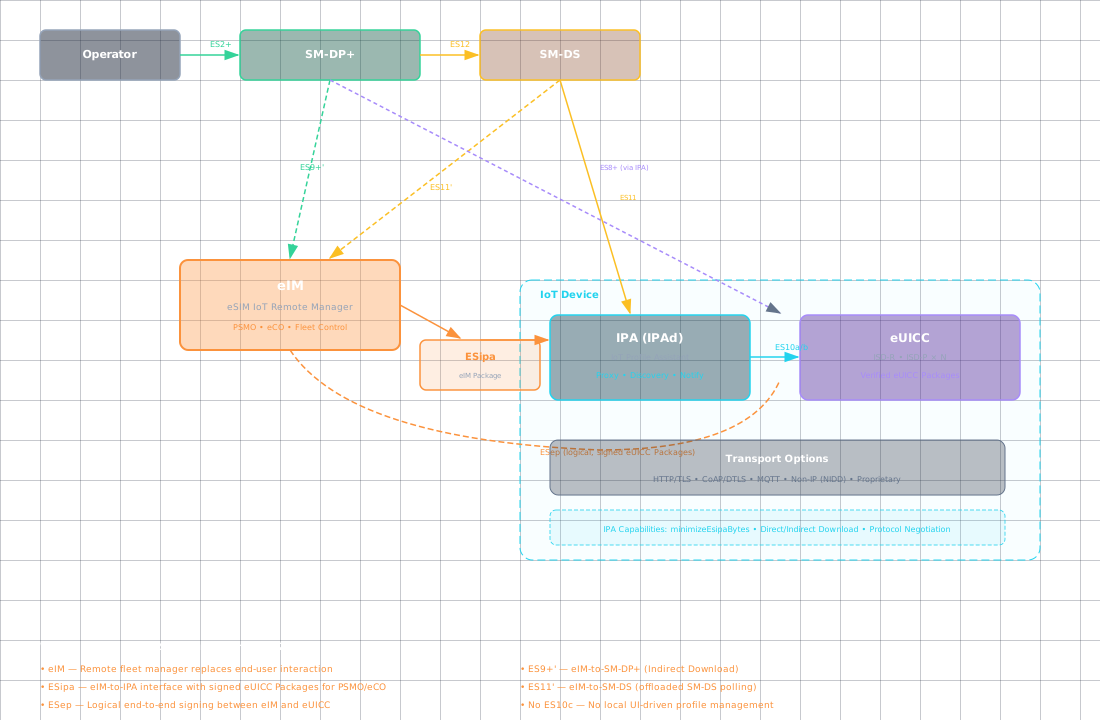
IPA in the eUICC (IPAe)
Same topology, but the IPA lives inside the eUICC alongside ISD-R and ISD-Ps. The IoT Device becomes a thinner shell: the IPAe communicates with the eIM via the device’s modem stack (CoAP/DTLS or HTTP/TLS), and the device itself doesn’t need to understand eSIM protocols at all. This is ideal for ultra-constrained devices.
The Players
eIM: eSIM IoT Remote Manager
The remote brain. The eIM:
- Triggers profile downloads by pushing Activation Codes or SM-DS Events to the
IPA - Sends eIM Configuration Operations (
eCO) to manage associated eIMs on the eUICC - Sends Profile State Management Operations (
PSMO): enable, disable, delete - Receives installation reports and notifications
- Can be part of a larger device management platform (LwM2M server, AWS IoT, Azure IoT Hub)
- Uses its own PKI certificates (
CERT.EIM.ECDSAfor signing,CERT.EIM.TLSfor transport)
The eIM can configure itself as an “Associated eIM” on the eUICC: a cryptographically trusted relationship that persists across power cycles. Once associated, the eIM can send signed eUICC Packages that the eUICC verifies without needing to go through the full SM-DP+ mutual authentication flow.
IPA: IoT Profile Assistant
The on-device proxy. The IPA provides four functions:
| Function | Role |
|---|---|
| Discovery Service | Retrieves Event Records from SM-DS (when polling is used) |
| Profile Download | Two-stage proxy: (1) downloads Bound Profile Package from SM-DP+ in single transaction, (2) transfers it into the eUICC in SCP03t segments |
| PSMO / eCO Conveying | Forwards Profile State Management Operations and eIM Configuration Operations between eIM and eUICC |
| Notification Handling | Forwards installation results and errors to the eIM and SM-DP+ |
The IPA can also report its IPA Capabilities: telling the eIM what it can handle, including whether it supports compact data structures for minimising bytes over ESipa.
A key capability flag is minimizeEsipaBytes: when set, the IPA uses abbreviated ASN.1 tag structures to reduce airtime on constrained links.
The Four New Interfaces
SGP.32 adds four interfaces that don’t exist in consumer RSP:
ESipa: eIM to IPA
The workhorse. Carries:
- eIM Package Requests (signed by the
eIM): PSMOs (enable/disable/delete profiles) and eCOs (add/update/delete eIM configuration) IpaEuiccDataRequests:eIMasking theIPAto fetch data from the eUICC- Profile Download Triggers: Activation Codes or SM-DS Event Records pushed from
eIMtoIPA - IPA Capabilities exchange: What the
IPAsupports
Transport options: HTTPS over TCP, CoAPS over UDP/DTLS, or a proprietary protocol tunneled through the underlying transport layer (e.g., MQTT). This flexibility is critical: a CoAP-only LPWA device can’t speak HTTPS.
ES9+': SM-DP+ to eIM
The eIM’s direct line to the SM-DP+. Used when the eIM handles profile download orchestration server-side rather than through the IPA. Similar to consumer ES9+ but adapted for IoT flows.
ES11': SM-DS to eIM
The eIM retrieves Event Records from the SM-DS on behalf of the IPA. This is the “Option b” in profile download: the eIM polls the SM-DS, gets the event, then forwards it to the IPA via ESipa. This keeps polling traffic off the constrained IoT link entirely.
ESep: eIM to eUICC (logical)
A logical end-to-end interface between the eIM and the eUICC, tunnelled through ESipa. Carries eUICC Packages: cryptographically signed payloads containing PSMOs and eCOs that the eUICC verifies directly using the eIM’s public key (stored in the eIM Configuration Data).
The ESep interface is what makes remote profile management possible without a user: the eIM sends a signed package saying “enable profile X,” the eUICC verifies the signature against the eIM’s stored certificate, and executes the operation.
ESep is purely logical: there is no separate transport binding. eUICC Packages are carried inside ESipa and cryptographically verified end-to-end.
What’s Not in IoT
SGP.32 explicitly removes several consumer features:
- No
ES10cinterface : no local enable/disable/delete via LUI - No Activation Code retrieval : no QR code scanning
- No LUI or user-facing profile management
- No profile nicknames
The eIM replaces all of these. Everything is remote.
Communication Patterns
SGP.32 supports four protocol stacks for ESipa:
| Protocol | Transport | Security | Use Case |
|---|---|---|---|
| HTTPS | TCP | TLS | IP-connected devices with full stack |
| CoAPS | UDP | DTLS | LPWA, NB-IoT, LoRaWAN gateways |
| MQTTs | TCP | TLS | MQTT-based device management platforms |
| Proprietary | Any | Underlying layer | Custom IoT stacks |
The protocol choice is configured per-eIM in the eIM Configuration Data via the EimSupportedProtocol bitfield: the eUICC knows which protocol each associated eIM speaks.
Summary
- The IoT architecture adds
eIM(remote manager) andIPA(on-device proxy) with four new interfaces IPAcomes in two variants:IPAd(in device) for richer hardware,IPAe(in eUICC) for ultra-constrained devices- All profile decisions are remote: the
IPAis a conduit, and consumer LUI/ES10c features are removed - Four protocol stacks (HTTPS, CoAPS, MQTTs, Proprietary) let the architecture scale from LPWA sensors to Linux gateways
Based on GSMA SGP.32 v1.3, Sections 2.1-2.3 and SGP.31 v1.3, Section 4
| ← Previous: eSIM for IoT: Why It Needed Its Own Architecture | Section Index | Next: IoT Profile Download: Direct, Indirect, and eIM Package Handling → |