eUICC.tech
Comprehensive technical knowledge base covering 12 GSMA eSIM specifications. 84+ articles on Remote SIM Provisioning — SGP.02, SGP.22, SGP.32, SGP.41, SGP.29, SGP.23, SGP.25, SGP.26 and more.
Project maintained by AlexsCodingAgent Hosted on GitHub Pages — Theme by mattgraham
IoT Profile Download: Direct, Indirect, and eIM Package Handling
eUICC.tech > SGP.32 IoT eSIM > IoT Profile Download: Direct, Indirect, and eIM Package Handling
Why this matters: Profile delivery in IoT doesn’t look anything like scanning a QR code on a phone. SGP.32 defines two parallel download paths: Direct (IPA-to-SM-DP+) and Indirect (eIM-mediated), plus a cryptographically signed eIM Package protocol that replaces every consumer interaction with a single binary blob. Choosing the right path for your device’s connectivity model is central to any IoT eSIM deployment.
Key takeaways:
- Direct download:
IPAtalks to SM-DP+ directly, triggered by Activation Code or SM-DS Event- Indirect download:
eIMhandles all SM-DP+ interaction,IPAnever connects to SM-DP+- eIM Packages are cryptographically signed payloads carrying PSMOs and eCOs: replacing all consumer user interactions
- Two SM-DS polling options: Option A (IPA polls) for IP-connected devices, Option B (eIM polls) for constrained devices
- Replay protection via per-eIM
counterValue(max 8,388,607) and optionalassociationToken
Profile delivery in the IoT world has two paths: the IPA talks directly to the SM-DP+ (Direct), or the eIM mediates everything (Indirect). Both coexist in SGP.32, and the choice depends on the IoT device’s connectivity model.
Direct Profile Download
The IPA handles the download directly with the SM-DP+. Two triggers exist:
Triggered by eIM with Activation Code
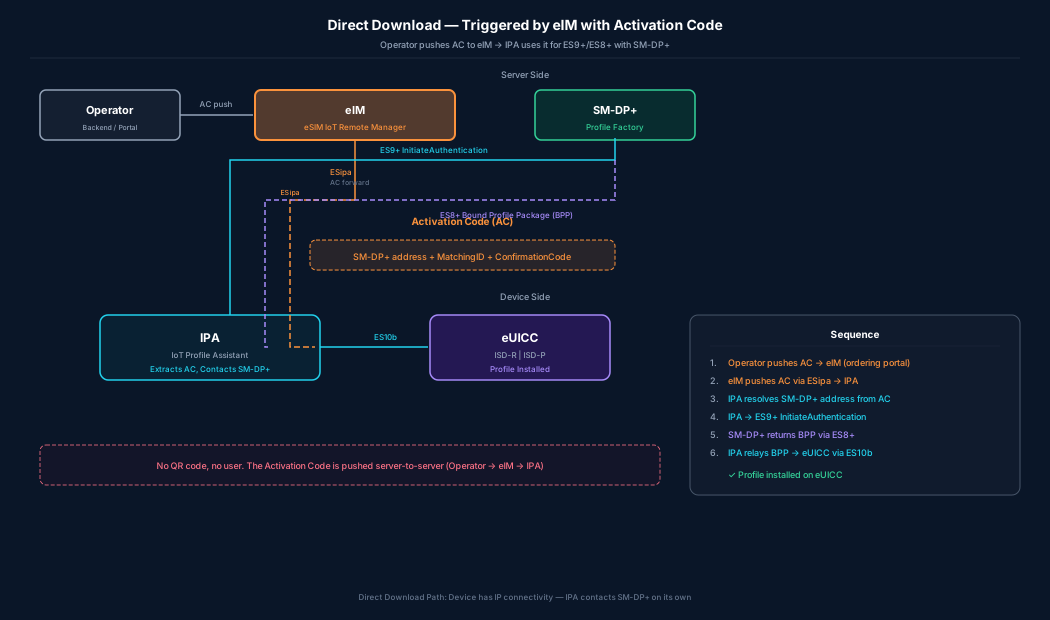
The Activation Code is pushed from the operator’s backend to the eIM, no QR code, no user. The IPA’s job is to identify the SM-DP+ from the AC and relay the ES8+ messages.
Triggered by eIM with SM-DS Event
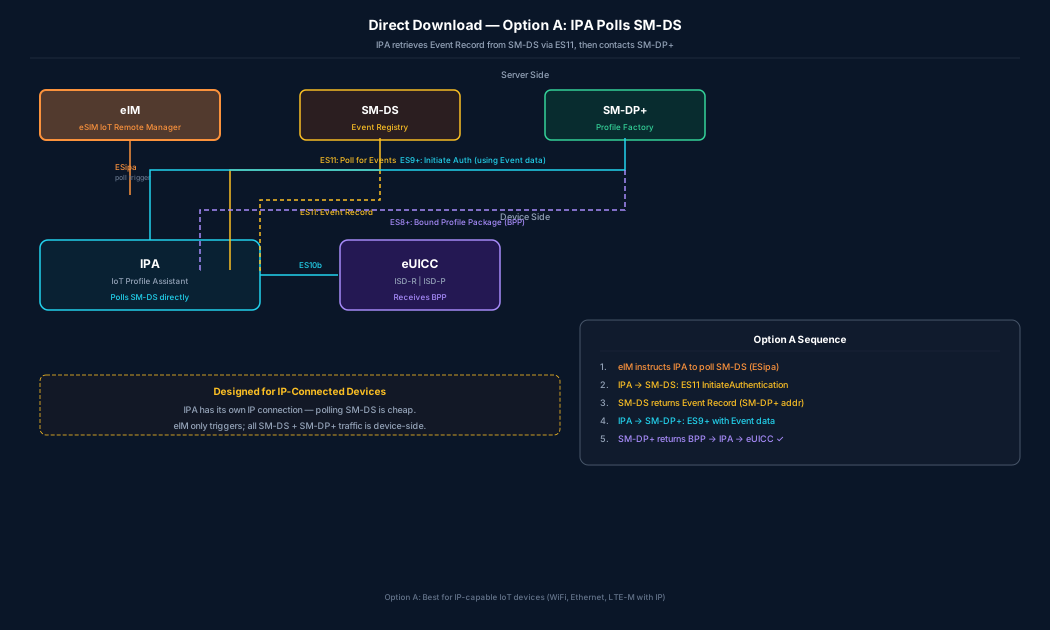
Two options exist for who retrieves the Event Record:
Option A: IPA polls SM-DS:
Option B: eIM polls SM-DS:

Option B is designed for Network Constrained Devices: devices on LPWA networks where the airtime cost of polling the SM-DS directly would be prohibitive. The eIM does the heavy lifting on the server side, where bandwidth is free.
Indirect Profile Download
In Indirect mode, the eIM handles the entire SM-DP+ interaction. The IPA never opens a connection to the SM-DP+. This is used when:
- The IoT device can only reach the
eIM(no internet access) - The
eIMacts as a security gateway, terminating TLS and re-encrypting - The device uses a non-IP protocol that only the
eIMunderstands
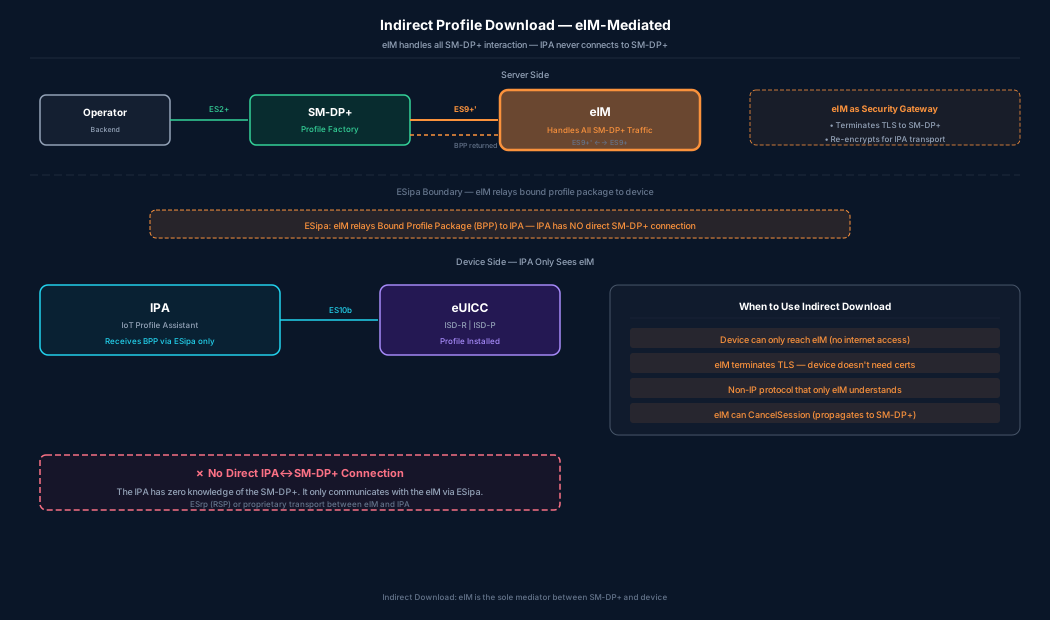
The eIM can also cancel an in-progress Indirect session using CancelSession, which propagates to both the SM-DP+ and the eUICC.
The eIM Package Protocol
This is the most significant IoT innovation. An eIM Package is a cryptographically signed payload sent from the eIM to the eUICC through the IPA. It replaces the entire consumer “user opens LUI, taps Enable, confirms” flow with a single signed binary blob.
eIM Package Request Structure
EuiccPackageRequest ::= [80] SEQUENCE {
 euiccPackageRequestData CHOICE {
 psmoList SEQUENCE OF Psmo, -- Profile State Management
 ecoList SEQUENCE OF Eco, -- eIM Configuration
 euiccMemoryReset ...,
 executeFallbackMechanism ...
 },
 eimSignEpReq OCTET STRING, -- eIM's ECDSA signature
 eimCertificate Certificate OPTIONAL, -- eIM's signing certificate
 eimTransactionId TransactionId OPTIONAL -- Correlates request to result
}
PSMO (Profile State Management Operations)
Psmo ::= CHOICE {
 enableProfile EnableProfileRequest,
 disableProfile DisableProfileRequest,
 deleteProfile DeleteProfileRequest,
 rollbackProfile RollbackProfileRequest,
 setFallbackAttribute SetFallbackAttributeRequest,
 unsetFallbackAttribute UnsetFallbackAttributeRequest
}
Each PSMO targets a profile by ICCID or ISD-P AID. The eUICC verifies the eIM’s signature against the public key stored in its EimConfigurationData before executing any operation.
eCO (eIM Configuration Operations)
Eco ::= CHOICE {
 addEim [8] EimConfigurationData, -- Associate a new eIM
 deleteEim [9] SEQUENCE {eimId},
 updateEim [10] EimConfigurationData, -- Update eIM credentials
 listEim [11] SEQUENCE {} -- List associated eIMs
}
The eUICC supports multiple Associated eIMs: each with its own public key, counter value, and protocol configuration. A device could be managed by both its manufacturer’s eIM (for provisioning) and the customer’s eIM (for operational management).
Replay Protection
Each eIM Package carries a counterValue, a monotonically increasing integer. The eUICC stores the highest received value per eIM and rejects any package with a lower or equal counter. The maximum counter value is 8,388,607 (0x7FFFFF), enough for 800 operations per day for 28 years.
An optional associationToken provides additional protection against entire sequence replay after eIM removal and re-addition.
eIM Package Result
After executing the package, the eUICC generates a signed result:
EuiccPackageResult ::= CHOICE {
 euiccPackageResultDataSigned SEQUENCE {
 psmoResultList SEQUENCE OF PsmoResult,
 ecoResultList SEQUENCE OF EcoResult
 },
 euiccPackageErrorSigned EuiccPackageError
}
The result is signed by the eUICC using SK.EUICC.ECDSA and returned to the eIM via the IPA. The eIM verifies the signature against CERT.EUICC.ECDSA.
Error Handling
Both the eUICC Package and the IPA level have structured error codes:
| Component | Error Example | Meaning |
|---|---|---|
| IPA | incorrectTagList |
ASN.1 parsing failed at IPA |
| IPA | euiccCiPKIdNotFound |
Requested CI key not on eUICC |
| IPA | ecallActive |
Emergency call in progress: no eSIM ops allowed |
| eUICC | counterValueOutOfRange |
Replay attack or overflow |
| eUICC | eimNotFound |
eIM trying to delete itself but not associated |
| eUICC | insufficientMemory |
No room for new eIM configuration |
| eUICC | ciPKUnknown |
CI public key identifier not recognised |
The eIM-IPA Data Exchange
Between eIM operations, the IPA and eIM synchronise:
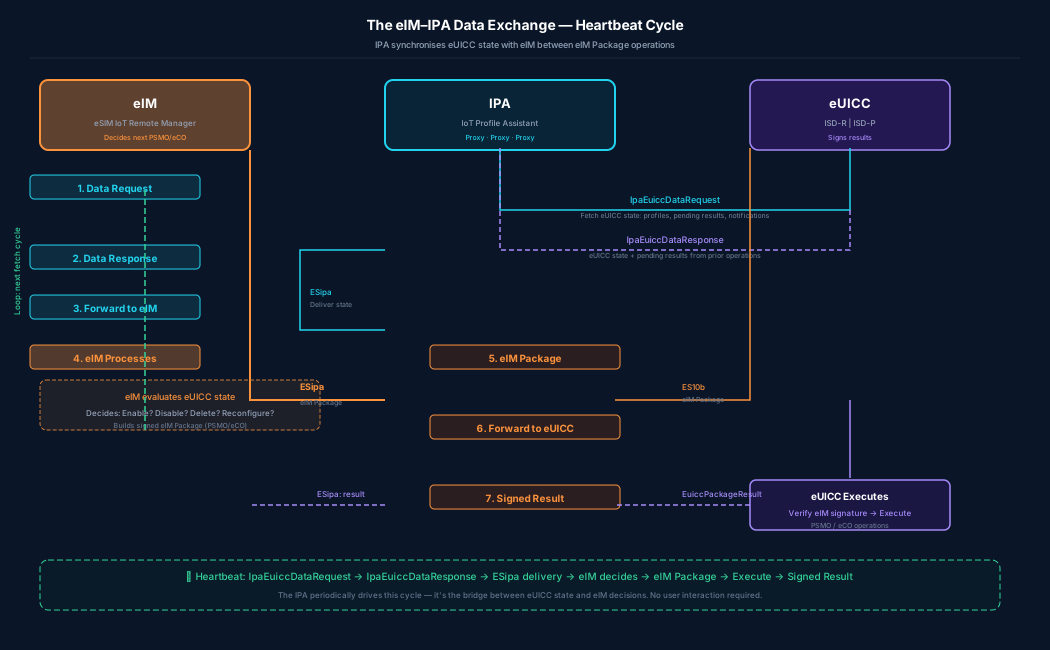
This is the heartbeat of the IoT eSIM system: the IPA periodically fetches state from the eUICC and delivers it to the eIM, along with any pending results from previous operations. The eIM uses this data to decide what to do next.
IPA Capabilities
The IPA reports its capabilities to the eIM via IpaCapabilities:
minimizeEsipaBytes: compact ASN.1 encoding (reduced tag structures)- Ability to handle direct vs indirect downloads
- Supported transport protocols
- Whether it can proxy SM-DS communication
This lets the eIM adapt its behaviour to the specific IPA implementation: a full IPAd on a Linux gateway behaves very differently from an IPAe on a battery-powered NB-IoT sensor.
Summary
- Direct download keeps the
IPAin the loop with SM-DP+; Indirect download delegates all SM-DP+ interaction to theeIM - eIM Packages replace every consumer user interaction (enable, disable, delete) with a single cryptographically signed binary blob
- Replay protection combines a monotonic per-eIM
counterValuewith an optionalassociationToken - The
IpaEuiccDataRequest/IpaEuiccDataResponsecycle serves as the heartbeat, synchronising eUICC state with theeIM
Based on GSMA SGP.32 v1.3, Sections 2.11, 3.1-3.4 and SGP.31 v1.3, Section 6
| ← Previous: The eSIM IoT Architecture: eIM, IPA, and the New Interfaces | Section Index | Next: IoT eSIM Security: eIM Certificates, DTLS, and Device Trust → |